1. Curriculum Design Philosophy
Students in their first and second years follow a common curriculum, taking foundational courses in both audiology and speech-language sciences.
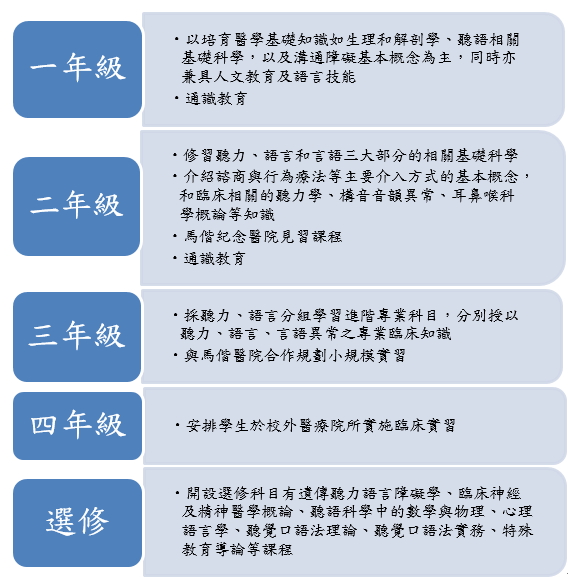
In the first year, the curriculum focuses on foundational medical knowledge such as physiology and anatomy, basic sciences related to speech-language and hearing, and fundamental concepts of communication disorders. Humanistic education and language skills are also included.
In the second year, students begin studying foundational courses in audiology, speech-language pathology, and speech sciences. Core topics include basic concepts of counseling and behavioral therapy as intervention approaches, as well as clinical-related subjects such as audiology, articulation and phonological disorders, and an introduction to otolaryngology.
In addition, the general education curriculum adopts a whole-person education approach to cultivate students’ aesthetic appreciation and character development. This training helps students maintain breadth and sensitivity in clinical assessment, develop teamwork awareness, and deliver effective client-centered services.
From the third year onward, students are divided into audiology and speech-language tracks, where they take advanced professional courses in hearing, language, and speech disorders. In the fourth year, students complete clinical internships in external medical institutions to integrate theory with practice.
To ensure early exposure to clinical practice, students begin observation training at Mackay Memorial Hospital in the second semester of the second year. In the third year, a small-scale practicum is conducted in collaboration with Mackay Memorial Hospital.
Elective Courses
To provide a more diverse range of elective options, the Department offers courses such as Introduction to Clinical Neurology and Psychiatry, Psycholinguistics, Theory and Practice of Auditory-Verbal Therapy, Introduction to Special Education, Taiwanese Sign Language, Research Methods, Case Study, Sign Language Communication and Deaf Culture, and Special Speech Disorders (e.g., cleft palate and laryngeal cancer patients).
The curriculum is designed to meet the university’s minimum graduation requirement of 128 credits, including 28 credits of general education courses and at least 4 elective credits within the major.
All course information is listed on the Department’s official website and is available for reference at any time. In addition, the Department Chair introduces the overall curriculum structure to freshmen each academic year, and academic advisors provide guidance on course selection each semester to support students in achieving integrated self-learning and career planning throughout the four-year program.